How Long Does Concrete Take to Cure? A Homeowner's Guide
One of the most common questions homeowners ask after a new driveway or patio is poured is simple:
when can I use it? It is an important question, because using concrete too soon is one of the easiest ways to damage a surface you expect to last for decades.
The short answer is that concrete takes about 28 days to reach its full strength, but you can use it in stages well before that. Understanding how long concrete takes to cure, and what happens at each milestone, helps you protect your investment and plan around the project.
This guide breaks down the curing timeline in plain terms, explains the difference between curing and drying, and covers the local conditions in Ventura and Los Angeles Counties that can speed up or slow down the process. If you are still in the planning stage, our guide to the
best time of year to pour concrete in California pairs well with this one.
Curing Versus Drying: Why the Difference Matters
It is natural to assume that concrete simply dries out and hardens, like paint. It does not. Concrete gains its strength through a chemical reaction called hydration, in which the cement and water in the mix bond together to form strong crystalline structures. This reaction continues for weeks, and it actually requires moisture to proceed properly.
That distinction has a practical consequence. If concrete dries out too fast, hydration stalls, and the result is a weaker surface that is more prone to fine cracks and surface dusting. This is exactly why professional crews keep fresh concrete moist, cover it, or apply a curing compound during the first several days. Keeping the surface from drying too quickly is the single most important thing you can do to help new concrete cure strong.
The Concrete Curing Timeline
Concrete gains strength quickly at first and then more gradually. Roughly 70 percent of its final strength develops in the first 7 days, with the remainder building toward the 28-day benchmark. The table below summarizes the milestones most homeowners care about for a standard residential mix under normal conditions.
| Time After Pour | Strength Gained | What You Can Do |
|---|---|---|
| 2 to 4 hours | Initial set | Surface stiffens; do not touch or load it |
| 24 to 48 hours | Early strength | Careful foot traffic; walk gently, no dragging |
| 7 days | About 70 percent | Light passenger vehicles; forms usually removed |
| 28 days | Full strength | Full use, including heavier vehicles and loads |
These are general milestones under moderate conditions, roughly 50 to 90 degrees Fahrenheit with proper curing. Cooler weather stretches the timeline, while a well-managed warm-weather pour tends to track close to these numbers. Your contractor can give you exact guidance for your specific slab, mix, and the season.
When Can You Walk on New Concrete?
For most residential pours, the surface is firm enough for careful foot traffic after 24 to 48 hours. At this stage the concrete has completed its initial set and feels solid, but it is still far from full strength. Walk gently during this early window, and avoid dragging patio furniture, ladders, or equipment across the surface, since the young concrete can scuff or mark easily. In cooler months, give it closer to the longer end of that range before stepping on it.
When Can You Drive on a New Concrete Driveway in Thousand Oaks?
Driveways are where timing matters most, because vehicles apply far more stress than foot traffic. As a general rule, wait about 7 days before driving a passenger car on a new concrete driveway. By that point the concrete has reached roughly 70 percent of its designed strength, enough to handle a car driven on carefully.
Heavier vehicles are a different story. Trucks, RVs, trailers, and anything with concentrated weight or narrow tires should wait the full 28 days, when the concrete has reached its full strength. Driving heavy loads on a driveway too early can cause corner cracking, surface abrasion, and weakening that may not show up until years later. If you are planning a new driveway, our guide to concrete driveway installation explains the full process, and our breakdown of driveway pricing in How Much Does a Concrete Driveway Cost in Southern California helps you budget for it.
What Affects How Fast Concrete Cures in Southern California
Several factors influence how quickly concrete moves through these milestones. Temperature is the biggest one. Warm conditions speed up hydration, while cool conditions slow it down, which is why a winter slab needs more time before it is ready for use. Humidity matters too, since dry air pulls moisture from the surface and can disrupt curing if the concrete is not protected.
Slab thickness plays a role, with thicker pours holding their curing heat longer. Mix design is another factor, as some mixes are formulated to gain early strength faster than standard blends. Finally, curing practice itself makes a real difference: concrete that is kept moist and protected cures more completely than concrete left to dry on its own.
Southern California's climate adds its own wrinkles. During a hot, dry inland summer afternoon in areas like Thousand Oaks or Simi Valley, water can evaporate from the surface faster than the concrete can use it, causing fine surface cracks called plastic shrinkage cracks. Along the coast near Ventura and Oxnard, the marine layer and higher humidity slow evaporation and support a steadier cure. A local contractor reads these conditions and adjusts curing accordingly.
How Ventura County Contractors Protect a Fresh Pour
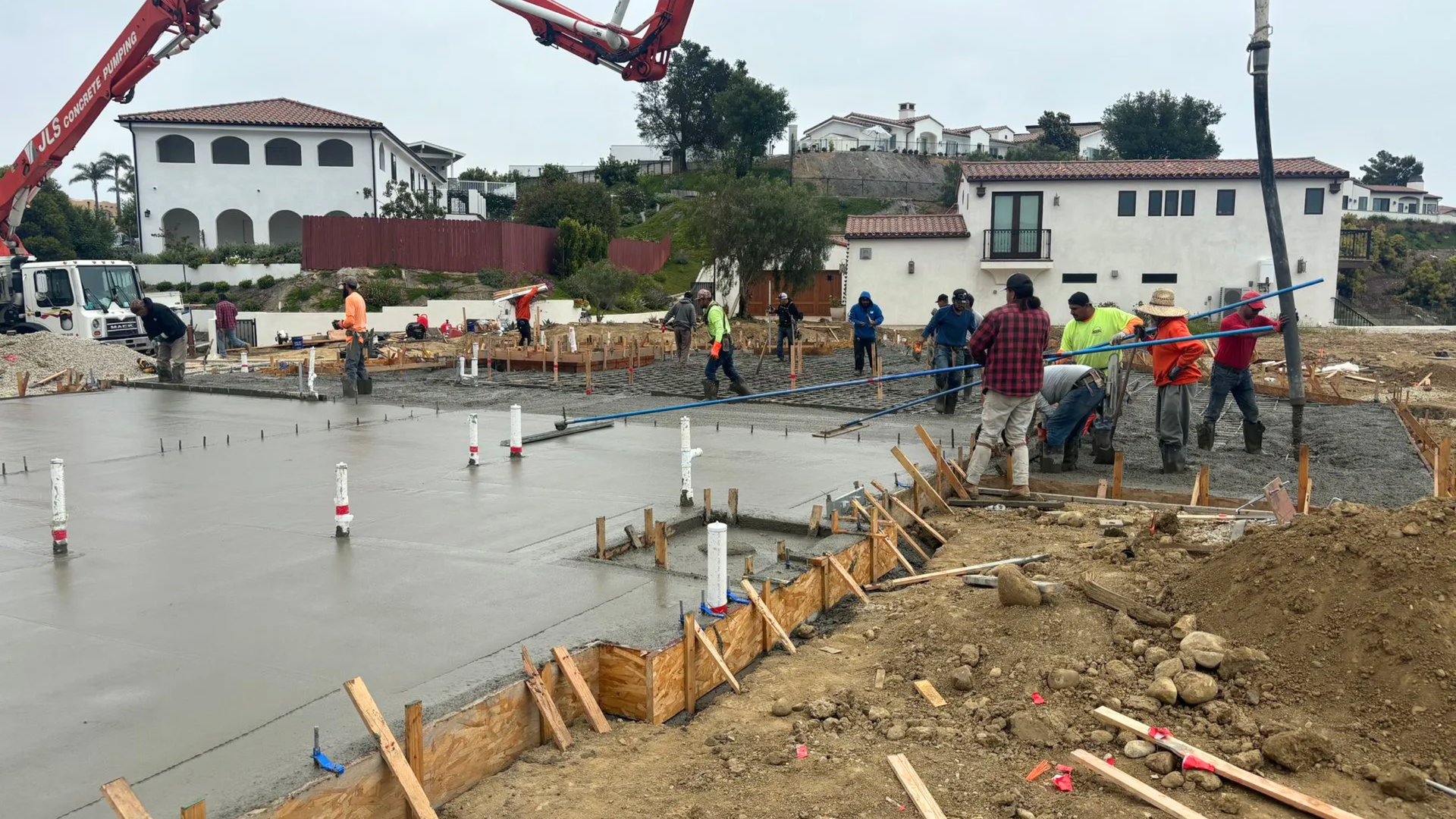
Good curing is not left to chance. In warm or dry weather, crews mist the surface, apply curing compounds, and sometimes cover the slab to hold in moisture during the critical first days. Proper subgrade preparation before the pour helps the concrete cure evenly and resist cracking. These steps are a routine part of a professional installation, and they are a major reason a properly cured slab outlasts a rushed one.
The same care applies across project types. A concrete patios surface benefits from steady curing before furniture returns, and a structural foundations and concrete slabs pour follows the same 28-day path to full strength with attention to moisture and temperature along the way. Whatever the project, the curing period is where a durable result is either protected or compromised.
Tips for Protecting Your New Concrete
While your contractor handles the technical side of curing, there are a few simple things you can do to help.
- Keep vehicles and heavy items off the surface until the recommended milestones have passed.
- Avoid placing anything with sharp points or narrow legs directly on young concrete.
- If your contractor asks you to keep the surface damp or leave a covering in place, follow that guidance closely during the first week.
- Resist the temptation to test the driveway early; a few extra days of patience protects decades of use.
Frequently Asked Questions
How long does concrete take to cure?
Concrete reaches its full design strength about 28 days after it is poured. It gains strength quickly at first, reaching roughly 70 percent of its strength in the first 7 days, then continues more slowly toward the 28-day mark. In practical terms, you can usually walk on new concrete after 24 to 48 hours, drive a passenger vehicle on it after about 7 days, and use it without restriction after 28 days.
When can you walk on new concrete?
Most concrete is firm enough for careful foot traffic after 24 to 48 hours. During this early window the surface is set but still gaining strength, so it is best to walk gently and avoid dragging furniture or equipment across it. In cooler weather the surface may need a little longer before it is ready.
When can you drive on a new concrete driveway?
As a general rule, wait about 7 days before driving a passenger vehicle on a new concrete driveway, since the concrete has reached roughly 70 percent of its strength by then. For heavier vehicles, trailers, or RVs, it is safest to wait the full 28 days. Cooler temperatures can extend these timelines, so follow your contractor's guidance for your specific pour.
What is the difference between concrete curing and drying?
Drying is simply moisture leaving the surface, while curing is the chemical reaction, called hydration, that actually builds strength. Concrete does not gain strength by drying out. In fact, keeping it moist during the first week helps it cure stronger. This is why crews mist fresh concrete, cover it, or apply curing compounds rather than letting it dry quickly.
Does concrete cure faster in hot weather?
Concrete sets faster in hot weather, but faster is not stronger. On a hot, dry day the surface can lose moisture before hydration is complete, which weakens the concrete and can cause surface cracks. Ideal curing happens at moderate temperatures with good moisture control, which is why timing and curing practices matter, especially during warm inland summers.
Conclusion: Patience Protects Your Investment
Concrete rewards patience. It is safe for careful foot traffic within a day or two, ready for a passenger car in about a week, and fully cured at 28 days, and respecting those milestones is one of the simplest ways to get decades of service from a new surface. Just as important is how the concrete is cured in those first critical days, which is where professional preparation and moisture control make the difference between a slab that lasts and one that fails early.
If you are planning a concrete project anywhere in Thousand Oaks, Ventura County, or Santa Barbara County, the team at Stoneworks Construction Services can pour, finish, and cure it to last. Reach out to request a free estimate and get expert guidance tailored to your project and the season.